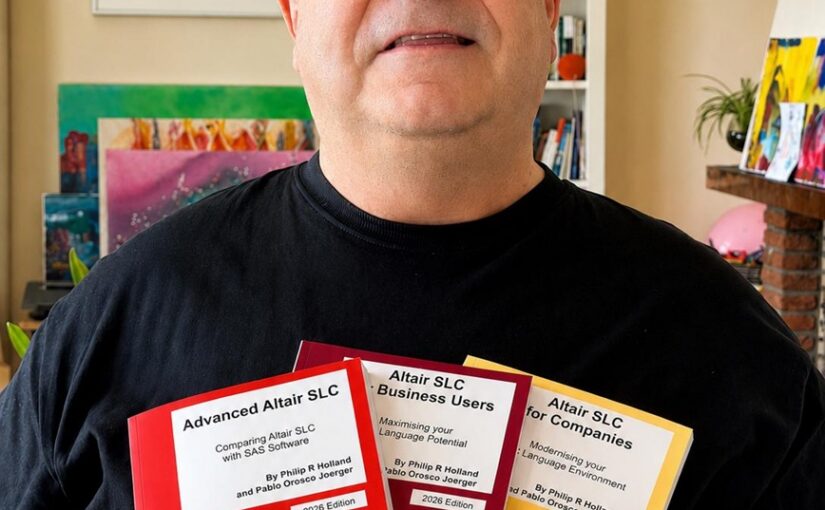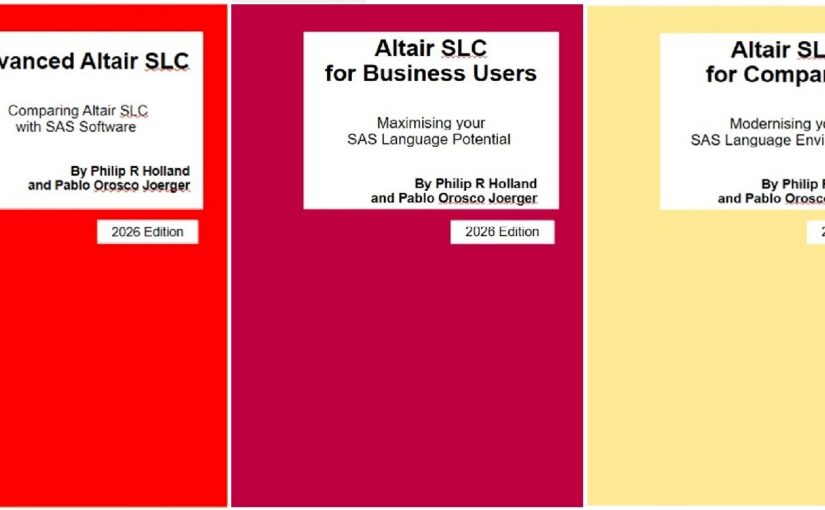
Pablo and I will be enjoying a “book launch” lunch in Hamburg on 20Aug2026. You are very welcome to join us!

Loading

Philip R Holland and Pablo Orosco Joerger will be at The Locks, Marienhof 6, 23399 Hamburg, a bar and restaurant in northern Hamburg, Germany, between 1200 and 1600 on 20Aug2026 to talk to interested readers about their 3 new books:

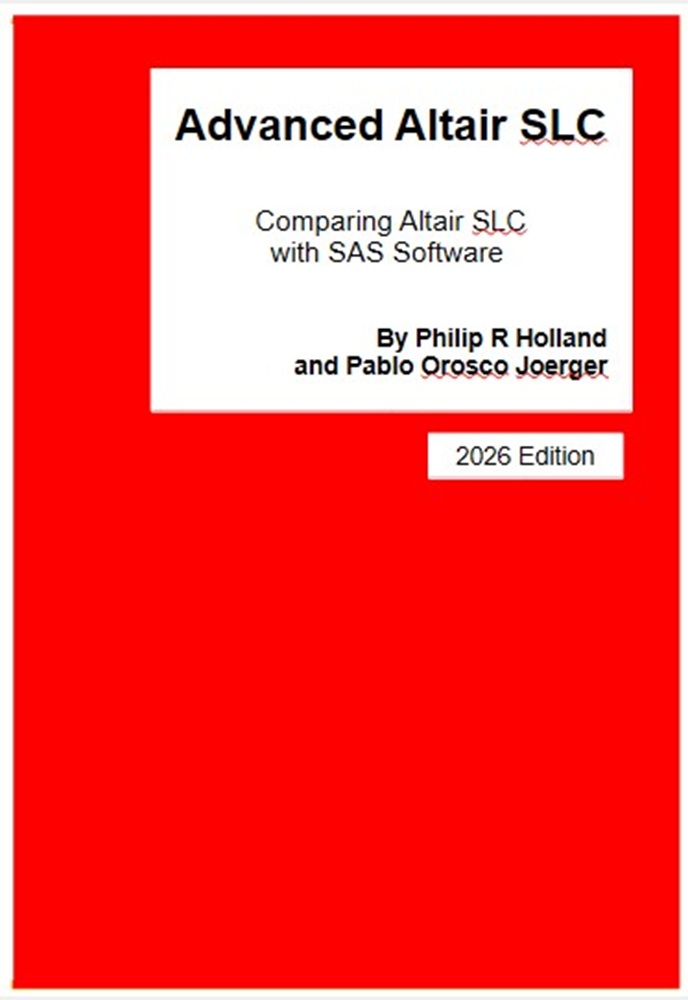
  • Advanced Altair SLC
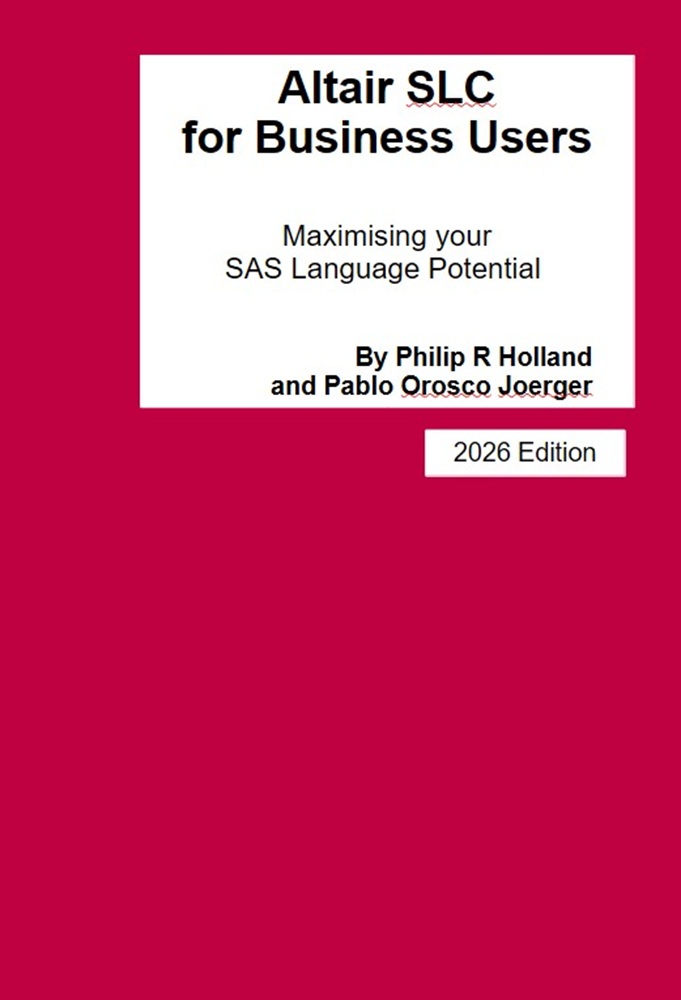
  • Altair SLC for Business Users
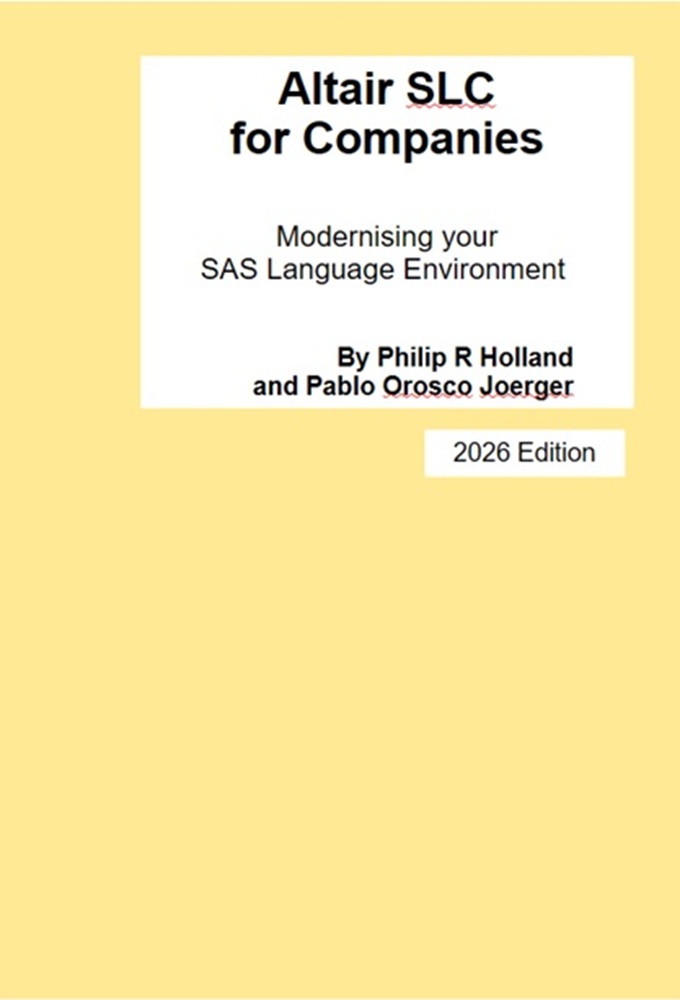
  • Altair SLC for Companies
VolumePrimary audienceCore value proposition
Advanced Altair SLCExperienced SAS/SLC programmersTechnical depth: PROC R/PROC IML/PROC PYTHON with full programs, ODS gaps, clinical CDISC programming, non‑standard file reading/writing, systematic SLC vs SAS 9.4 differences
Altair SLC for Business UsersSAS programmers and analysts adopting SLC as their primary toolBroadest practical coverage: batch processing, server access, database access, R/Python, SASjs integration, clinical programming – all with working code
Altair SLC for CompaniesIT managers, architects, decision-makers evaluating migrationBusiness case: cost and capability comparison with SAS 9.4 and Viya, migration planning checklist, database engine coverage, server architecture

All 3 books are available on hollandnumerics.org.uk and Lulu.com as ebooks and paperbacks, if you are unable to join us:

Discounted ebooks will be available to purchase at the venue, either via email or on USB drives.

Discounted paperbacks can also be requested from the authors.

Buy 3 new ebooks about Altair SLC directly from this blog site at pre-publication prices

Loading

Pablo Orosco Joerger and I have been writing these 3 ebooks about Altair SLC since October 2024, but before we officially publish them we wanted to offer the latest versions for you to buy, read and review at discount prices. As with other ebooks on this blog, any ebooks bought will have any new editions sent directly to you by email when they are published at a later date at no extra charge. We would just like you to read them, and maybe suggest updates and improvements, and write reviews for the blog site and inside the ebooks for the next editions.

  • Buying ebooks from this blog site requires the buyer to create a blog profile, which includes their email address.
  • This email address will be used to send them the ebook, but should also be maintained over time so that future editions can be sent out for free. The next edition will be the first officially published edition, which could include your review!

Click on the cover images of each of these books to visit the book pages to find out what they are about, or visit the Book Table:

Converting mySQL database to MariaDB: findings so far…

Loading

On 02Nov2025 I was effectively forced to migrate my blog site’s database from mySQL to MariaDB. Fortunately open-source MariaDB is advertised as compatible with mySQL, so all I did during the migration was:

  1. Replace the mySQL database in the blog site Docker container with an empty MariaDB database by creating a new Docker volume for MariaDB.
  2. Start the blog container, restore the WordPress plugins, and restore the most recent database backup. Remember the MariaDB is compatible with mySQL!
  3. Restart the blog container.

I have now been running the blog site with MariaDB for a week, so what have I noticed?

  • The server is no longer running out of disk space due to frequently created large log files in the database volume (previously mySQL, but now MariaDB). Was there an underlying problem in mySQL?
  • I had been using MariaDB for my ownCloud database in a separate Docker container, but, now that I am running 2 instances of MariaDB in separate containers, there are NO interactions, even though the same database software is being used by both containers! Note that I could, in future, use different versions if necessary.
  • MariaDB feels that it is running faster than mySQL, but, while I have no data to prove this, it is no longer creating any log files, so my feeling may not be just subjective.
  • Not using mySQL means that I am no longer dependent on Oracle support for my databases. Note that I have, for a long time, been using software applications and platforms supported by open-source communities (LibreOffice, WordPress, Linux, Lulu.com, ownCloud, Eclipse, JavaScript, Perl, PHP, GraphViz, and now MariaDB).

3 new things I have learnt about Altair SLC this week

Loading

  1. I have always wanted to create a neural network using the SAS language from the moment it was announced, but SAS software restricted this feature to paid-for components that I had no other use for. However, using features available in the free Personal Edition of Altair SLC and Altair Analytics Workbench, I have created a neural network to analyse the Iris data set, which uses PROC MLP, but I created it using pre-built nodes for a Workflow in Analytics Workbench.
  2. I have just watched a video demo from an Altair Employee on the Altair Community site about importing EG project files into Analytics Workbench Workflows. No version numbers were mentioned in or around this video, but it appears to be possible now, or at least soon!
  3. For business users the Linux installation of Altair SLC is treated as a server, rather than a workstation, installation. However, when I installed it I thought that the only way to access it would be as a server from a Windows-installed Analytics Workbench, but there is also a Linux version of Analytics Workbench available to business users, and it looks just like the Windows version.

More reasons to consider migrating from Foundation SAS to Altair SLC!

Keep your eyes open for more books about Altair SLC coming soon…