Altair SLC 2026 series: Summary post #5

Loading

For the background to this series of summary posts see Altair SLC 2026 series: Introduction to posts.

Book links:

Book A: Advanced Altair SLC

Comparing Altair SLC with SAS Software

A-05  From CDISC ADaM data to a validated comparison

A clinical chapter written by people who have done the work.

It follows the data journey end to end: acquisition and cleaning, transformation and integration, statistical analysis, visualisation, report generation. It covers the CDISC tooling that works with Altair SLC, from the Clinical Standards Toolkit to the R Pharmaverse.

Then it gets practical. Download the sample ADaM data, configure Altair SLC to read it, and build a macro that standardises and compares ADaM data sets.

The chapter closes with an exercise and a worked answer, because reading about clinical programming is not the same as doing it.

Advanced Altair SLC, chapter 8.

#ClinicalResearch #CDISC #ADaM #AltairSLC #StatisticalProgramming

Book B: Altair SLC for Business Users

Working with Altair SLC day to day

B-05  Everything you actually have to read and write

The data never arrives in the format you wanted.

One chapter in Book B covers what a working programmer really reads and writes: delimited files with PROC IMPORT, PROC EXPORT and ODS CSV; Excel through the XLSX and EXCEL LIBNAME engines and through ODS EXCEL; Microsoft Access; dBase; MySQL and MariaDB; ODBC through both the ODBC and ODBCOLD engines; and OLEdb.

The database connections added in Altair SLC 2026 are listed separately from those already there in 2025, so you can tell at a glance whether an upgrade solves your problem.

Altair SLC for Business Users, chapter 7.

#AltairSLC #Excel #ODBC #SQL #DataEngineering

Book C: Altair SLC for Companies

The case, the cost and the migration

C-05  Find out before you commit, not after

Will your SAS programs run in Altair SLC? You can find out before you spend anything.

Analytics Workbench syntax checks whole folders of programs through Analyse then Program Compatibility, and reports missing procedures, system options, global statements and Data Step options to an Excel file. The free Personal Edition is enough to run that check.

Book C also lists the known false positives, so that DIMn() and LAGn() are not mistaken for blockers when they work perfectly well.

Altair SLC for Companies, section 10.2.1.

#AltairSLC #Migration #SAS #ITStrategy
Altair SLC 2026 series: Summary post #4

Loading

For the background to this series of summary posts see Altair SLC 2026 series: Introduction to posts.

Book links:

Book A: Advanced Altair SLC

Comparing Altair SLC with SAS Software

A-04  Three editors, one language

Three editors, one language.

The Altair SLC extension turns Visual Studio Code into a full editing and execution environment for SAS-language programs.

Book A installs and configures it, then compares it directly with SAS Studio and with the SAS extension for VSCode, so a team can decide which editor actually fits the way it works rather than the way it is marketed.

Advanced Altair SLC, chapter 7.

#AltairSLC #VSCode #SASStudio #StatisticalProgramming

Book B: Altair SLC for Business Users

Working with Altair SLC day to day

B-04  It is the code text that is sent, not the file

Open a program on your laptop, right-click, and run it on the Linux server.

It is the code text that is sent, not the file, and every ODS destination on the remote server is honoured, so the output lands where you expect it.

Altair SLC Link behaves much like Enterprise Guide or SAS Studio connecting to a remote server. Altair SLC Communicate offers a second route. Book B configures both, and then shows the automatic macro variables that tell you, from inside the program, where it is actually running.

Altair SLC for Business Users, chapter 6.

#AltairSLC #RemoteServers #SASProgramming #Linux

Book C: Altair SLC for Companies

The case, the cost and the migration

C-04  What a session actually costs

What does an Altair SLC session actually cost?

A personal computer consumes 10 units. A server operating system consumes 10 per logical CPU, with a minimum of 40. Analytics Workbench itself consumes none.

Units are consumed by device, not by process, so the first user to start a session on a shared server takes the units and everyone after that shares them. Close the session and the units come back.

Book C works the arithmetic through with real examples, and shows exactly what a batch job and a Workbench session report when there are no units left.

Altair SLC for Companies, sections 4.4 to 4.5.

#AltairSLC #Licensing #CapacityPlanning #ITOperations

Altair SLC 2026 series: Summary post #3

Loading

For the background to this series of summary posts see Altair SLC 2026 series: Introduction to posts.

Book links:

Book A: Advanced Altair SLC

Comparing Altair SLC with SAS Software

A-03 PROC R and PROC PYTHON, in the same program as your DATA step

PROC R. PROC PYTHON. In the same program as your DATA step.

Data goes in, results come back, and the SAS-language program stays in charge. PROC IML gives a second route to R for anyone who already works that way.

Book A states what each procedure requires, sets up the Python editor in Analytics Workbench, and then gives three complete worked programs, one for each route.

No bridge to configure, no separate environment to keep in step.

Advanced Altair SLC, chapter 6.

#AltairSLC #RStats #Python #SAS #DataScience

Book B: Altair SLC for Business Users

Working with Altair SLC day to day

B-03 In batch, sas becomes wps

Moving a scheduled job to Altair SLC? In batch, sas becomes wps. Most of the rest of the command line you already know.

Two things worth knowing before you start. Batch comes with a full licence, the Personal Edition does not include it. And on Windows the Altair SLC bin folder has to go into the Path environment variable before the command line becomes usable.

Book B gives both the Windows and the Linux configuration, and the practical considerations that apply once jobs run unattended.

Altair SLC for Business Users, chapter 5.

#AltairSLC #BatchProcessing #Automation #SAS

Book C: Altair SLC for Companies

The case, the cost and the migration

C-03  The free edition, and the trap on the way back

The Personal Edition of Altair SLC is free, and it includes all the programming features. That makes it the cheapest way to evaluate anything.

But the two installation cases behave very differently. A first-time installation on a machine that has never held Altair SLC or WPS is straightforward. Switching back to the Personal Edition on a machine that has run under a managed, on-premises or wpskey licence is considerably harder than the short published procedure suggests.

Book C documents both, including how to test that the switch worked and what to do when it did not.

Altair SLC for Companies, sections 4.1 to 4.3.

#AltairSLC #Licensing #ITOperations

Altair SLC 2026 series: Summary post #2

Loading

For the background to this series of summary posts see Altair SLC 2026 series: Introduction to posts.

Book links:

Book A: Advanced Altair SLC

Comparing Altair SLC with SAS Software

A-02  There is no session, there is a workspace

The first thing that surprises a SAS programmer opening Altair Analytics Workbench: there is no session. There is a workspace.

That one difference changes how you set the current working folder, how file types are associated, and how a server is assigned before anything will run.

Book A shows the 2024 and 2025 releases side by side, how to identify the installed version on Windows 11 and on Linux, and compares Workbench feature by feature with SAS Enterprise Guide.

If you are moving a team across, this is the chapter to read first.

Advanced Altair SLC, chapter 3.

#AltairSLC #SASProgramming #EnterpriseGuide #DataAnalytics

Book B: Altair SLC for Business Users

Working with Altair SLC day to day

B-02  Where your defaults come from

Two sessions, same program, different results. Almost always the defaults.

Altair SLC has two kinds: those built into the product, and those set in the configuration file. Until you know which is which, a session is not reproducible on anybody else’s machine.

Book B gives the initialisation procedure for Altair SLC 2026 step by step, for Windows and then for Linux, and separates the two kinds of default option properly.

Altair SLC for Business Users, section 2.3.

#AltairSLC #Reproducibility #SASProgramming #Linux

Book C: Altair SLC for Companies

The case, the cost and the migration

C-02  Four products, two tables

Altair SLC. Foundation SAS 9.4. SAS Viya. SAS Viya Workbench.

Book C compares all four in two tables. The first summarises the pricing model of each product from publicly available information. The second compares capability and scope across primary positioning, deployment model, execution engine and language support.

It is deliberately short, because it is written to be put in front of people who will not read the rest of the book.

Altair SLC for Companies, section 3.3.

#AltairSLC #SASViya #DataAnalytics #ITStrategy

Altair SLC 2026 series: Summary post #1

Loading

For the background to this series of summary posts see Altair SLC 2026 series: Introduction to posts.

Book links:

Book A: Advanced Altair SLC

Comparing Altair SLC with SAS Software

A-01  Run it once, publish it five ways

Run the analysis once. Publish it five ways.

ODS DOCUMENT captures the output of a procedure. PROC DOCUMENT replays it later to a different destination, in a different style, without running the analysis again.

It is one of the most useful things in the Output Delivery System, and one of the least used. Altair SLC supports it, and Book A works through a complete example.

The same chapter sets out where the ODS implementation in Altair SLC matches SAS software, and where it does not.

Advanced Altair SLC, chapter 2.

#AltairSLC #SAS #ODS #StatisticalProgramming

Book B: Altair SLC for Business Users

Working with Altair SLC day to day

B-01  Altair SLC is a runtime, not an interface

Altair SLC is a runtime, not an interface.

That distinction matters, because there are several ways to reach it: Analytics Workbench, the command line, Visual Studio Code, a remote server, or another application driving it.

Book B lays the routes out plainly, so that a new user knows which one they are actually using, and why the same program can behave differently depending on how it was started.

Altair SLC for Business Users, sections 2.1 to 2.2.

#AltairSLC #SASProgramming #DataAnalytics

Book C: Altair SLC for Companies

The case, the cost and the migration

C-01  Why organisations are making the move

Why are organisations moving to Altair SLC?

Four reasons, and Book C gives the detail behind each. Cost, from a subscription model with a lower upfront commitment. Flexibility, from multi-language support for Python, R and SQL and an open architecture that fits an existing pipeline. A modern approach, with current machine learning and automation. And a comprehensive feature set under a single licence, rather than assembled from separately priced modules.

Written for the people who have to sign it off, not for the people who will use it.

Altair SLC for Companies, sections 3.1 to 3.2.

#AltairSLC #DataAnalytics #ITStrategy #Procurement

Altair SLC 2026 series: Introduction to posts

Loading

Twenty-four ready-to-post items promoting the three Altair SLC books, eight for each. No topic appears twice. Where a subject is covered by more than one book it has been assigned to the book that treats it most fully, so the three sets could be scheduled in any order without repeating any information.

The three books at a glance

BookPagesAudience to aim the posts at
Book A – Advanced Altair SLC: Comparing Altair SLC with SAS Software210Experienced SAS programmers. Technical detail earns the engagement here; lead with the specific.
Book B – Altair SLC for Business Users207Programmers and analysts doing the daily work. Practical, problem-and-answer posts.
Book C – Altair SLC for Companies142Managers, architects and procurement. Cost, risk and migration; keep these the shortest.

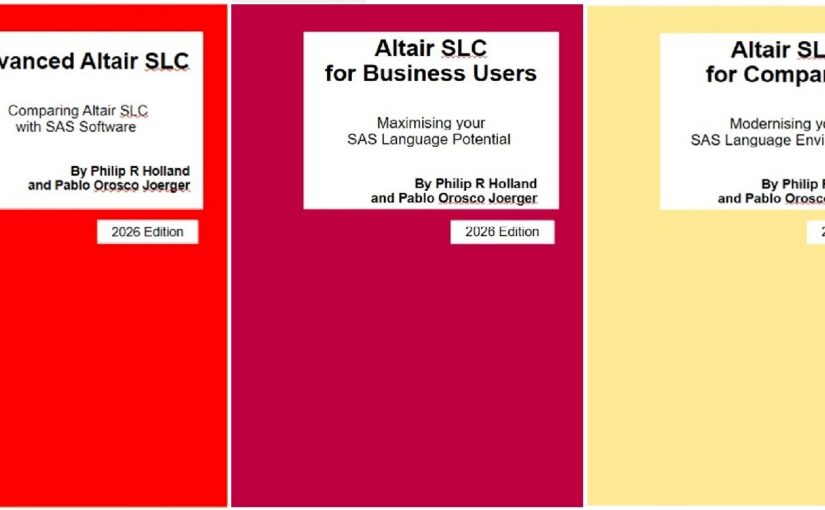
All three are by Philip R Holland and Pablo Orosco Joerger, 2026 edition, first printing, July 2026:

Each post will include the purchasing links above, but also a link back to this post to explain the target audiences.

Altair SLC 2026: ebook bundles are now available at discounted prices

Loading

Each of the 3 Altair SLC ebooks in the 2026 series are aimed at different target audiences, but there are groups of readers that may prefer to buy discounted bundles than rely on a single book to answer their questions about Altair SLC.

Note that, during Siemens’ rebranding period, the SLC software still uses the name Altair SLC internally, but is labelled RapidMiner SLC in the MarketPlace. However, as software users, we will still use Altair SLC as the software’s name.

The three books at a glance

BookPagesAudience to aim the posts at
Book A – Advanced Altair SLC: Comparing Altair SLC with SAS Software210Experienced SAS programmers. Technical detail earns the engagement here; lead with the specific.
Book B – Altair SLC for Business Users207Programmers and analysts doing the daily work. Practical, problem-and-answer posts.
Book C – Altair SLC for Companies142Managers, architects and procurement. Cost, risk and migration; keep these the shortest.

All three are by Philip R Holland and Pablo Orosco Joerger, 2026 edition, first printing, July 2026.

There are now 3 bundles available:

Stop Press: Look out for the Altair SLC 2026 series summary posts – 24 posts (8 for each book) on LinkedIn and on this blog to explain what is in the 3 books.

Apologies to all my loyal blog members, and thank you for your patience over the last few weeks…

Loading

Those of you who have tried to access my blog site during May and June experienced a very slow response, or, occasionally, no response at all, throughout the day. I have been investigating potential solutions, including using FPM (FastCGI Process Manager) to speed up the PHP programs. I was close to implementing this solution, but had actually made no changes, when the response times suddenly improved dramatically earlier this week. The performance improvements have been very welcome, but I have no explanation for them yet.

I do still intend to implement FPM, but there is less urgency now.

So, while the blog site is user-friendly again, don’t miss out on the pre-publication discounts on the new Altair SLC ebooks at The Book Table. More details can be found at Download pre-publication copies of my new books at discounted prices.

PS. You may have read that Altair SLC has been rebranded by Siemens as Rapidminer SLC, but this name has yet to appear in the software itself or its documentation, so the book titles will remain the same for now!

Buy 3 new ebooks about Altair SLC directly from this blog site at pre-publication prices

Loading

Pablo Orosco Joerger and I have been writing these 3 ebooks about Altair SLC since October 2024, but before we officially publish them we wanted to offer the latest versions for you to buy, read and review at discount prices. As with other ebooks on this blog, any ebooks bought will have any new editions sent directly to you by email when they are published at a later date at no extra charge. We would just like you to read them, and maybe suggest updates and improvements, and write reviews for the blog site and inside the ebooks for the next editions.

  • Buying ebooks from this blog site requires the buyer to create a blog profile, which includes their email address.
  • This email address will be used to send them the ebook, but should also be maintained over time so that future editions can be sent out for free. The next edition will be the first officially published edition, which could include your review!

Click on the cover images of each of these books to visit the book pages to find out what they are about, or visit the Book Table:

Who’s going to SAS Global Forum 2022? Apparently no-one!

Loading

In a SAS Blog post Jenn Chase has announced that the flagship SAS Global Forum 2022 will be split into many AI and Analytics events, some virtual and some face-to-face:

  • Q1 – SAS Amplify:
    A virtual conference for SAS Partners.
  • Q2 – SAS Innovate:
    Face-to-face conferences for Business in the Americas, EMEA and Asia Pacific regions. So far only the conference in the Americas 2022 has been scheduled in San Diego, CA, where it was to hold SAS Global Forum 2022.
  • Q1/Q2 – SAS Hackathon:
    Virtual competition to convert curiosity into innovation.
  • Q3/Q4 – SAS Explore:
    A virtual conference for SAS Technologists.

I’ve also found a number of other links with information about these changes:

  1. A New Era of SAS Global AI and Analytics Events
  2. For those of you who are members of the SAS Professional Forum on LinkedIn, then you can read Andrew Howell post discussing his feelings about the changes from his own perspective as a non-US SASGF attendee and presenter: “A New Era of SAS Global AI and Analytics Events”. But SAS Global Forum is no more..
Please select your product